


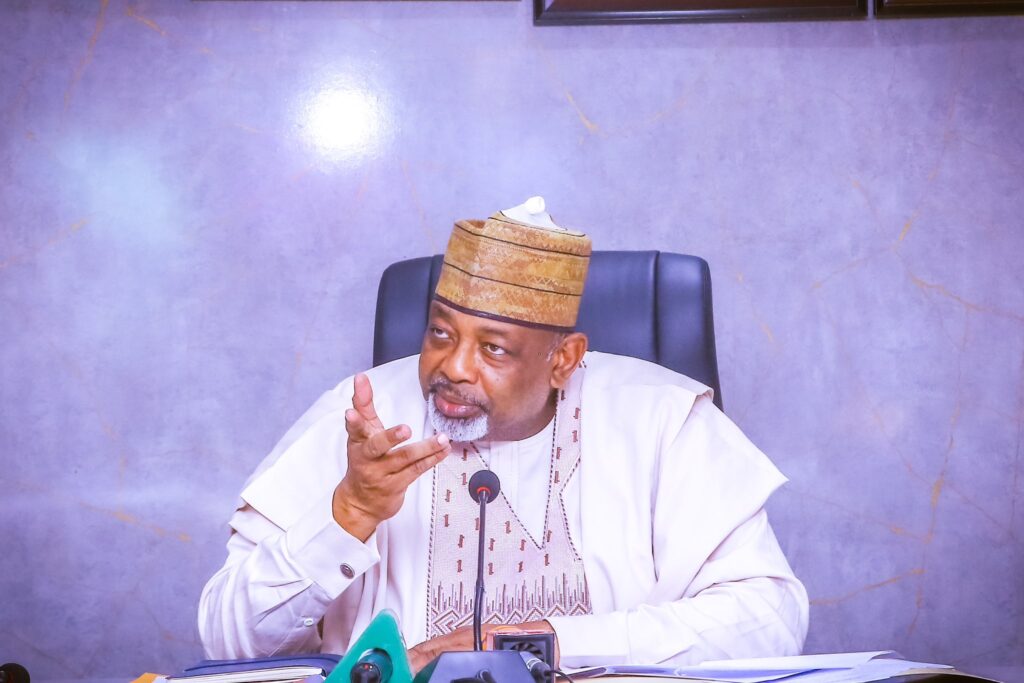
The Minister of Agriculture and Food Security, Senator Abubakar Kyari, has urged African countries to develop agricultural technologies suited to their own needs instead of relying primarily on innovations developed elsewhere.
Kyari made the call on Monday, while opening the 9th Africa Agriculture Science Week (9AASW) and the 10th General Assembly of the Forum for Agricultural Research in Africa (FARA) in Abuja.
He said Africa’s ability to harness science, technology and innovation would determine the success of its agricultural transformation.
“Knowledge has become the most valuable agricultural resource of the twenty-first century, Our ability to harness this knowledge through science, technology and innovation will determine whether we achieve the agricultural transformation we all seek, Africa must move beyond technology consumption,” Kyari said.
He added that Africa should develop technologies that respond to its ecological conditions, production systems and development priorities.
“Africa must not simply adopt innovations developed elsewhere. We must become a global leader in generating agricultural technologies that respond to our own ecological realities, production systems and development aspirations,” he said.
Kyari said agriculture remained central to the Federal Government’s economic agenda, stressing that food security was closely linked to national security, economic prosperity and social stability.
He listed ongoing reforms in irrigation, mechanisation, digital agriculture, agro-industrialisation and agricultural financing.
According to him, artificial intelligence, satellite technology, biotechnology, digital platforms and data science would shape the future of African agriculture.
Kyari also challenged research institutions to ensure their work produced measurable economic and social benefits beyond academic publications.
“Research should increase productivity, stimulate enterprise development, generate employment for our youth, and strengthen the resilience of our farming communities to climate change,” he said.
The Minister of Livestock Development, Idi Mukhtar Maiha, said Nigeria was implementing reforms to modernise the livestock sector following the creation of the Federal Ministry of Livestock Development.
He said the ministry’s National Livestock Growth Acceleration Strategy and Master Plan focused on sustainable production, infrastructure, value-chain development and animal health.
“We invite the private sector, development partners and the scientific community to partner with us across the entire livestock value chain. There are enormous opportunities in modern livestock production, processing, storage, logistics, feed formulation and advanced veterinary pharmaceuticals,” Maiha said.
He said scientific innovation would support improved livestock breeds, disease surveillance and climate-smart production while helping Nigeria meet rising demand for animal protein.
The Executive Secretary of the Agricultural Research Council of Nigeria, Dr Abubakar Adamu Dabban, said sustained investment in agricultural research and technology could strengthen food systems and improve livelihoods.
“Through sustained investment in agricultural research, innovation and technology, we can build resilient agrifood systems, enhance productivity, ensure food and nutrition security, and improve the livelihoods of millions of Africans,” Dabban said.
The Managing Director of AKADEMIYA 2063, Dr Debisi Araba, said Africa had recorded agricultural growth but continued to struggle with inadequate financing and technology adoption.
“We proved we could restore agricultural growth between 2003 and 2013. What we haven’t achieved yet is matching that ambition with adequate financing,” Araba said.
He identified underinvestment in innovation, weak technology adoption and institutional capacity gaps as major challenges, adding that “technologies exist but adoption doesn’t.”
The Chairperson of the FARA Board of Directors, Ms Bongiwe Njobe, said science and technology were essential to translating agricultural policy commitments into measurable results.
“Science, technology and innovation are the engines that will convert political commitments into measurable results at farm and household level,” Njobe said.
The Chief Executive Officer of the Pan African Farmers’ Organization, Dr Babafemi Oyewole, called for farmers to participate as equal partners in agricultural research rath
er than remain passive beneficiaries.