


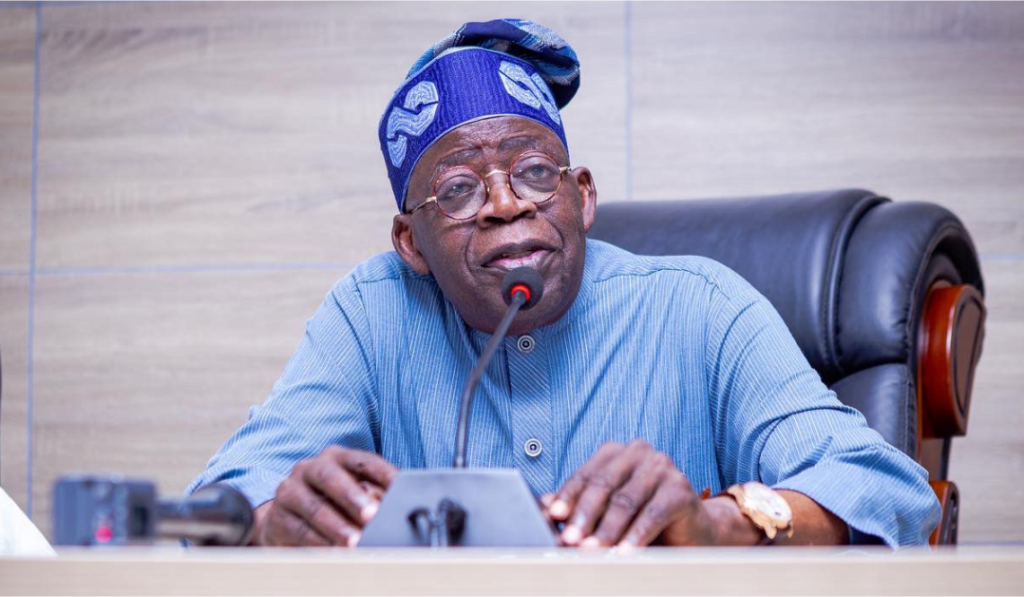
It was his third independence anniversary speech, and the one before another election in which he is seeking a second term. But this one is not about the election. It is also not about qualification for another term. Rather, it is about the most daunting things that speak to every Nigerian, particularly the poor and whatever is left of the middle class. President Bola Tinubu’s speech on the 66th anniversary of the country as an independent nation would have been considered hollow had he not touched on poverty and food security.
He did not only speak about those sore issues, he also did not demonstrate any form of pretence about them. He gallantly admitted that they are the most problematic issues that his administration was faced with. The economy, he said, had left the intensive care unit, ICU, adding that Nigeria, which was critically sick, when he took office in 2023 is now doing well economically. The reforms of his administration, according to him, have changed the course of collapse. The next thing for the government to do is move from reform and stabilisation to prosperity and improved living standards.
Here, he said, the hero will be the farmer. Therefore, for agriculture, the message was particularly clear. The President placed the farmer, food production and the cost of moving agricultural commodities from farm to market at the centre of the next phase of his administration. But as Nigerians listen to promises of increased agricultural production, mechanisation, irrigation, fertiliser availability, storage and better transportation, an important question remains: When will these interventions translate into food that ordinary Nigerians can actually afford? That is perhaps the most important test of Nigeria’s agricultural policy at 66. But the president spoke to the challenges, as if his administration attaches a sense of immediacy to the issues of hunger and poverty.
The President promised in his October 1 address that the government’s objective is to reduce the cost of living by reducing the cost of producing and transporting goods. Specifically, he highlighted mechanised irrigation and dry-season farming, improved access to seeds and fertiliser, increased mechanisation and storage. President Tinubu tried to establish a connection between the roads being built by his administration to the transportation of farm produce to the markets and the impact of such roads on the cost of food items. So, the roads, railways and ports, which he said are being built to link farms with markets are expected to bring the expected better life to the average Nigerians. The President’s argument is straightforward: if farmers can produce at lower cost, if fewer crops are lost after harvest, and if agricultural commodities can move more efficiently to consumers, food prices should eventually fall.
From an agricultural economics perspective, this is an important approach because food security is not simply about producing more food. It involves availability, affordability, accessibility, stability and the purchasing power of households to enable them to obtain adequate and nutritious food.
The president said his administration has demonstrated support for farmers in the area of distribution of fertiliser and seedlings. For instance, the Federal Government announced the distribution of more than 10 million bags of fertiliser in 2026, alongside a Guaranteed Price Model targeting two million smallholder farmers. The government has also introduced a National Agricultural Mechanisation Policy and Investment Strategy, including plans for a tractor assembly plant with an annual capacity of between 2,000 and 4,000 tractors. There is an added effort in the emphasis on fertiliser value chains and last-mile distribution to farmers. Government figures released in June indicated that 515,720 bags of locally produced fertiliser were being distributed to 128,930 smallholder farmers across 25 states and the FCT. Nigeria is finally treating food security as the resolution of the problem of production and value chain.
One of the encouraging aspects of the President’s address is that it did not present agriculture simply as a question of giving farmers inputs. The emphasis on irrigation, mechanisation, storage, roads, rail, ports and market connections recognises that Nigeria’s food problem extends beyond the farm gate. This is important because a farmer can produce a good harvest and still fail to make reasonable income, if fertiliser and other inputs are expensive; the farm is inaccessible; insecurity prevents cultivation; produce cannot be transported cheaply; there is inadequate storage; post-harvest losses are high; processors lack capacity; middlemen and fragmented markets dominate; or farmers cannot obtain affordable credit.
The Minister of Agriculture and Food Security, Senator Abubakar Kyari, recently acknowledged precisely this problem. He said the government believes food production has increased and farm-gate prices have fallen, but inadequate processing and distribution continue to prevent consumers from enjoying corresponding reductions in retail prices. Nigeria may have a production problem, but it also has a distribution, processing and market-efficiency problem.
The difficult angle is that increased production has not yet meant cheap food and this is where the expectations of ordinary Nigerians collide with government policy. The Nigerian consumer does not buy fertiliser, tractors or cultivate land, rather the consumer buys rice, beans, gari, yam, tomatoes, vegetables, meat, fish, eggs, bread and other food products. Consequently, the ultimate measure of food-security policy for many households is not simply how many tractors have been deployed or how many fertiliser bags have been distributed. It is: “Can my family afford a nutritious meal today?”
Current evidence shows that this remains a major challenge. Food and Agriculture Organisation, FAO reported that Nigeria’s food inflation was still elevated in July 2026, at 20.3 percent, while insecurity continued to disrupt farming in several important agricultural states. FAO also identified high input costs as a constraint on cereal production. The News Agency of Nigeria’s Independence Day interviews with consumers and traders in Lagos similarly found concerns about food prices, insecurity, transportation costs and the cost of moving agricultural commodities.
One important observation from the interviews is the distinction between slower food inflation and cheaper food. If the price of food is rising more slowly, that is different from food prices actually falling. For a household whose income has already been severely eroded by previous price increases, a reduction in the rate of increase does not necessarily restore affordability. Interviews with market women, farmers and youth in Lagos, Kano and Port Harcourt show a common expectation: “We don’t want grammar, we want food that we can afford. If the government says prosperity, let us see it in the price of gari, rice and yam.” – Mrs. Aisha Bello, trader, Mile 12 Lagos.
That distinction should be central to the national food-security conversation. The farmer’s dilemma is to produce more, but at what cost? There is another side that deserves equal attention.
The government wants farmers to produce more. Nigerians want cheaper food. But the farmer also has to survive economically. If fertiliser, seeds, chemicals, labour, fuel, machinery and transportation become increasingly expensive, forcing the farmer to sell at very low prices may discourage production in the following seasons
This creates a difficult policy balance: Cheap food for consumers must not mean unsustainable prices for farmers. Agricultural policy must therefore seek a price structure that gives consumers reasonable access to food while providing farmers with sufficient returns to remain in production and reinvest.
President Tinubu made a convincing argument in his speech, to show that his administration has a clear understanding of what is at stake. He said, “I mean a Nigeria in which the farmer can cultivate his land safely, produce more at lower cost, and earn a decent return for his labour. A Nigeria in which factories have reliable power, businesses can obtain credit, and young people can find productive work. A Nigeria in which food and transportation are affordable, education is within reach, and hard-working families can look towards the future with confidence.This is the promise we must now fulfil.”
The President’s reference to farmers producing “more at lower cost” and earning a decent return is therefore significant. The challenge is turning that objective into reality across millions of smallholder farms.
Security remains a food-security policy. Perhaps no agricultural policy can succeed without addressing insecurity. FAO’s September 2026 assessment reported that conflict was severely disrupting agricultural activities in several major food-producing states, including Benue, Borno, Kaduna, Katsina, Niger, Plateau, Sokoto and Zamfara.
This means that food security is also a national-security issue. A farmer who cannot safely access his farmland cannot produce. A farmer who fears kidnapping cannot confidently expand his farm. A farmer who abandons a productive area because of insecurity reduces the country’s potential food supply. This is why the President’s statement that the Nigerian farmer should be able to cultivate safely is more than a rhetorical statement. It is a fundamental requirement for agricultural transformation.
There is one hidden problem and that is the middle of the value chain. One of the biggest lessons emerging from Nigeria’s current food situation is that increasing production alone may not solve food inflation. Consider a simple example: Farmer → Aggregator → Transporter → Processor → Wholesaler → Retailer → Consumer. If costs increase dramatically at several points along this chain, the consumer may continue to pay a high price even when the farmer receives a relatively low farm-gate price. This is why investment in storage, rural roads, processing, aggregation, cold chains, logistics and market information may ultimately be just as important as fertiliser distribution or provision of tractors and other inputs. The Minister of Agriculture and Food Security has specifically pointed to agro-processing and distribution as gaps that must be addressed. This should become one of the most closely monitored aspects of the government’s next phase.
At the age of 66, as an independent nation, citizens should not necessarily expect the government to make every food item cheap overnight. However, citizens can reasonably expect measurable improvements. The expectations should include:
1. Food production should increase. Government interventions should result in measurable increases in yields and total production—not merely increases in the number of programmes announced.
2. Food prices should become more affordable. The real test should be the purchasing power of ordinary households.
3. Farmers should be safer. Agricultural communities must be sufficiently secure for farmers to cultivate their full holdings.
4. Inputs should reach genuine farmers. Fertiliser, improved seeds, credit and mechanisation should reach farmers on time and at transparent prices.
5. Rural infrastructure should improve. Good roads, electricity, irrigation, storage and communication are essential components of modern agriculture.
6. Agro-processing should expand. Nigeria should increasingly process its agricultural commodities domestically rather than exporting raw materials and importing processed food.
7. Young people should see agriculture as a business. Agriculture must move beyond the image of subsistence farming towards commercially viable enterprises involving production, processing, logistics, technology and marketing.
8. The government should publish measurable results and citizens should be able to ask: How many farmers benefited? How many hectares were cultivated? What was the yield per hectare? How much food was produced? What happened to farm-gate prices? What happened to retail prices? How much post-harvest losses were prevented? How many jobs were created?
These indicators would provide a stronger basis for assessing agricultural policy than the number of programmes launched.
Nigeria has an unusual agricultural paradox. The country has: land, farmers, water resources, favourable agro-ecological zones and a huge domestic market, yet millions of Nigerians continue to struggle with food affordability. This suggests that the fundamental challenge is not simply lack of agricultural potential. It is the difficulty of converting these potentials into productive, commercially viable and affordable food systems. Nigeria must resolve this contradiction. The President’s Independence Day speech recognises part of this problem by connecting agricultural production with transportation, storage, infrastructure and the cost of living. But the coming months will determine whether the policy vision translates into measurable improvements.
Ultimately, food-security policy should be judged not only from government offices, farms or agricultural conferences but from Nigerian homes, the real test is the Nigerian kitchen. The most important question after the President’s Independence Day speech is therefore not simply: “How much food will Nigeria produce?” It is: “Will the average Nigerian be able to afford enough safe and nutritious food from that production?” That is the point where agricultural production meets household welfare. Nigeria can produce more maize, rice, cassava, tomatoes, livestock and other commodities and still have a food-security problem, if millions of citizens cannot afford them.
Equally, Nigeria cannot achieve sustainable food security by keeping food artificially cheap while farmers operate at losses. The country needs a functioning food system in which the farmer earns, the processor creates value, the transporter moves food efficiently, the trader operates competitively and the consumer can afford the final product.
In conclusion, President Tinubu’s Independence Day address provides a clear agricultural direction: more production, mechanisation, irrigation, improved inputs, storage, transportation and stronger connections between farms and markets. These are genuine positive developments in government agricultural interventions, but the concerns of citizens remain equally legitimate. Food prices remain high. Insecurity continues to restrict agricultural activity all over the country. Input and transportation costs remain significant. And increased production has not yet translated consistently into cheaper food at the retail level.
The next phase of Nigeria’s agricultural policy should therefore move beyond announcements and interventions to measurable food-security outcomes. For the Nigerian farmer, the expectation is simple: Give me security, affordable inputs, finance, infrastructure and a fair market.
For the Nigerian consumer, the expectation is equally simple: Make food available, accessible, nutritious and affordable.
And for the government, the challenge is to make both expectations possible at the same time. At 66, Nigeria’s agricultural success should ultimately be measured not by how much agricultural policy is announced, but by whether the farmer can prosper and the Nigerian family can afford to eat.
President Tinubu’s Independence speech correctly diagnoses the next battle – prosperity through production. His emphasis on mechanized irrigation, storage and farm-to-market infrastructure is commendable and aligns with global best practice for food security.
However, for a nation where over 32 million people are projected to face acute food insecurity in 2026, good intentions are not enough. The age of prosperity will only be believable when it reflects in the price of food in the market and the productivity on the farm.
The President has said “No looking back.” Nigerians agree – but they are looking at their plates.