


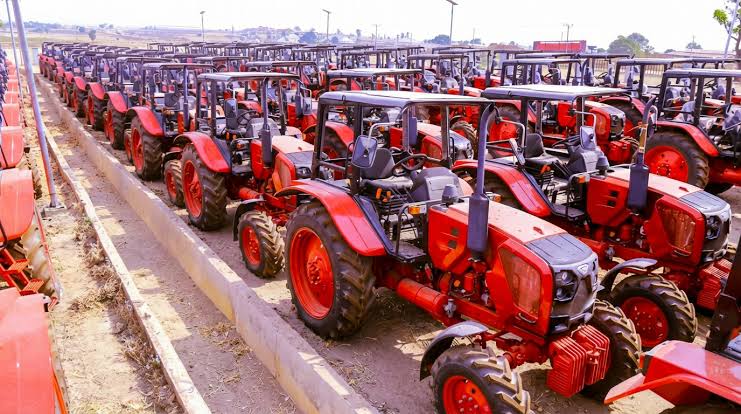
The Federal Government has unveiled the National Agricultural Mechanisation Policy and National Agricultural Mechanisation Investment Strategy, alongside plans for a tractor assembly plant capable of producing up to 4,000 units annually.
The government said the policy framework would support efforts to increase food production, reduce import dependence, create jobs and build a sustainable agricultural mechanisation ecosystem.
The statement was signed recently by Ezeaja Ikemefuna, Head, Department of Information, Federal Ministry of Agriculture and Food Security.
Speaking at the High-Level National Policy Dialogue on Agricultural Mechanisation in Abuja, the Minister of Agriculture and Food Security, Sen. Abubakar Kyari, said the two instruments would move Nigeria towards food sovereignty.
Kyari said the framework would move Nigeria “from agricultural potential to agricultural powerhouse; from mechanization deficit to mechanization leadership; and from food vulnerability to food sovereignty.”
He said mechanisation went beyond tractor ownership to include land preparation, planting, irrigation, crop protection, harvesting, processing, storage, logistics, precision agriculture, financing, insurance and maintenance.
“Our ambition, therefore, must be larger than equipment ownership.
We must build a Mechanization-as-a-Service economy in which technology reaches the farmer when and where it is needed, at a cost that is commercially viable and sustainably financed.
This is the direction in which Government is moving,” he said.
The minister said the Renewed Hope National Agricultural Mechanisation Programme had commenced procurement and deployment of 2,000 tractors, alongside more than 9,000 implements and spare parts.
He said a mega tractor assembly plant was also being planned to produce between 2,000 and 4,000 tractors annually.
Kyari said the plant would reduce dependence on imported machinery, localise production, create jobs and support the growth of a domestic mechanisation industry.
He urged investors, youths and women to participate in the sector, saying the government was seeking partners to build an agricultural technology and services ecosystem.
“Nigeria is open for investment in agricultural mechanization. We are not seeking capital merely to purchase machines. We are seeking partners to build an enduring agricultural technology and services ecosystem.”
The minister said the policy would require collaboration among the Federal Government, states, private investors, financial institutions, development partners and research institutions.
He also cited Borno State’s agricultural interventions, including the distribution of fertiliser and deployment of solar-powered irrigation systems, as examples of state-level support for mechanisation and food production.
Kyari commended TracTrac MSL for training young Nigerians as mechanisation service providers and deploying small-scale tractors to smallholder farmers.
The Permanent Secretary, Federal Ministry of Agriculture and Food Security, Dr. Marcus O. Ogunbiyi, said Nigeria must address persistent gaps in machinery, technology and investment across the agricultural value chain.
He said, “a tractor without an operator is an idle asset. A machine without maintenance is a depreciating investment. Equipment without finance cannot reach the farmer.”
Ogunbiyi said the government’s objective was to establish a national mechanisation ecosystem linking machinery with finance, operators, maintenance, spare parts, digital systems, research, standards, farmers and markets.
The Chairman of the dialogue, Borno State Governor, Prof. Babagana Zulum, commended the Federal Government’s agricultural policy and said mechanisation would help transform the sector.
The Minister of State for Agriculture and Food Security, Sen. Dr Aliyu Sabi Abdullahi, said mechanisation would improve farmers’ livelihoods and increase food production.
The CEO of TracTrac MSL, Godson Ohuruogu, said the dialogue marked a shift from discussions on mechanisation to implementation of a national policy and investment strategy.
The event featured the unveiling of the National Agricultural Mechanisation Policy and National Agricultural Mechanisation Investment Strategy.